At a moment when social cohesion is unraveling and institutional trust continues its long decline, Jared Angaza is advancing a fundamentally different response. It is not emerging from a think tank, a venture fund, or a political platform, but from a carefully constructed ecosystem bringing together Indigenous elders, digital architects, ecological designers, and sovereign communities.
Based in San Diego and working globally, Angaza leads Passage, an initiative positioned at the convergence of Indigenous epistemology, decentralized governance, and regenerative economics. Its core aim is not reform but reorientation: redesigning the foundations of modern systems—from artificial intelligence and agriculture to governance and philanthropy—by reintroducing relational values that shaped human societies for the majority of our species' history.
This work has already reached a significant milestone in Hawai'i, where Angaza is co-stewarding a multi-phase, $8 million social impact initiative centered on food sovereignty, land stewardship, and cultural revitalization in partnership with Native Hawaiian communities. Distinct from conventional philanthropy or NGO structures, the project is governed through a decentralized autonomous organization (DAO), enabling transparency while preserving Indigenous self-determination at scale.
A Strategist Beyond Silos
Angaza's professional trajectory spans more than two decades and multiple continents. His early work in East Africa included co-authoring a women's rights bill in Rwanda (now law), directing creative agencies in Kenya, and building income pathways for women affected by trafficking. He has advised institutions such as USAID, Human Rights Watch, and DAI, and has contributed to astronaut training initiatives at Blue Origin.
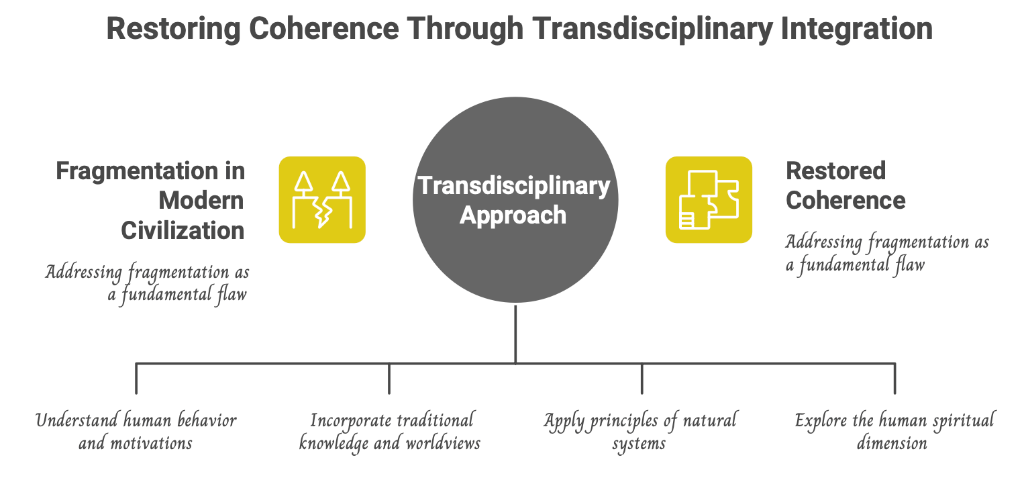
Yet his defining strength is not a conventional résumé. It is a transdisciplinary orientation that draws equally from behavioral science, Indigenous cosmologies, ecological design, and spiritual anthropology. Angaza applies systems thinking not to accelerate disruption, but to restore coherence—treating fragmentation itself as the core design flaw of modern civilization. This mirrors the regenerative design philosophy and LIFE Standard frameworks that embed relational intelligence into urban and ecological systems.
The Architecture of Passage
At the center of this work is Passage, a living ecosystem composed of several interlocking initiatives:
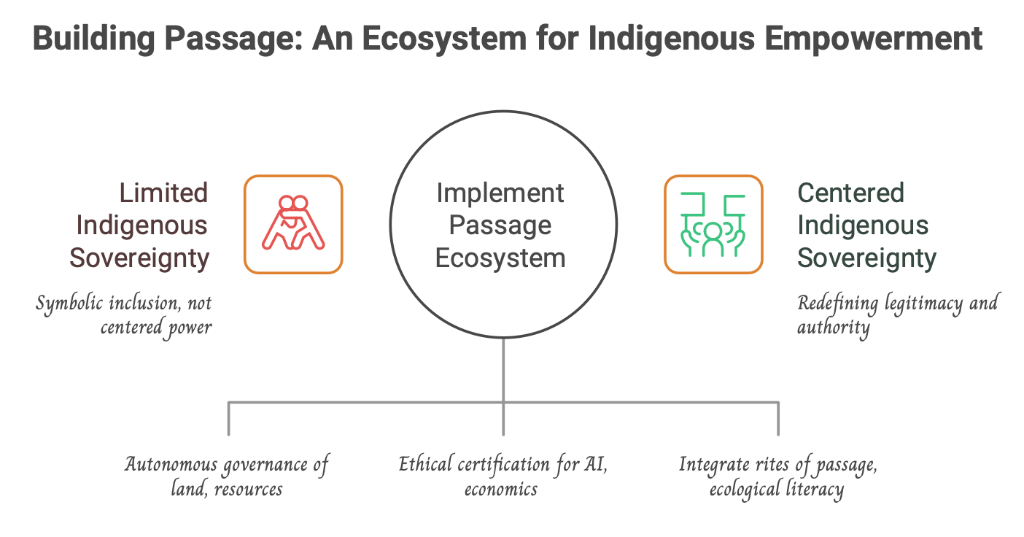
- PassageDAO — a sovereign-led digital infrastructure enabling Indigenous communities to govern land, resources, and data autonomously.
- The Coherence Protocol — an ethical certification framework translating Indigenous values such as reciprocity, accountability, and long-term responsibility into operational standards for AI, economic systems, and institutional governance.
- Immersive Leadership Retreats — co-designed with elders and facilitators to integrate rites of passage, ecological literacy, and embodied leadership practice.
Rather than imposing external frameworks, Angaza and his collaborators build scaffolding around Indigenous systems already in place. The objective is not symbolic inclusion, but centered sovereignty—a shift that fundamentally redefines legitimacy and authority in a post-colonial, climate-fractured world.
Recognition in Hawai'i and Beyond
In Hawai'i, Passage has earned trust in a landscape historically wary of extractive philanthropy and performative allyship. The initiative functions as a facilitative layer—resourcing cultural stewards, farmers, and land protectors without displacing them or redefining their priorities.
This posture—strategic yet deferential, technologically fluent yet culturally grounded—has enabled partnerships rooted in Aloha ʻĀina, rather than abstract equity metrics or short-term outcomes. The result is a model of engagement that strengthens existing leadership rather than replacing it.
An Emerging Discipline of Governance
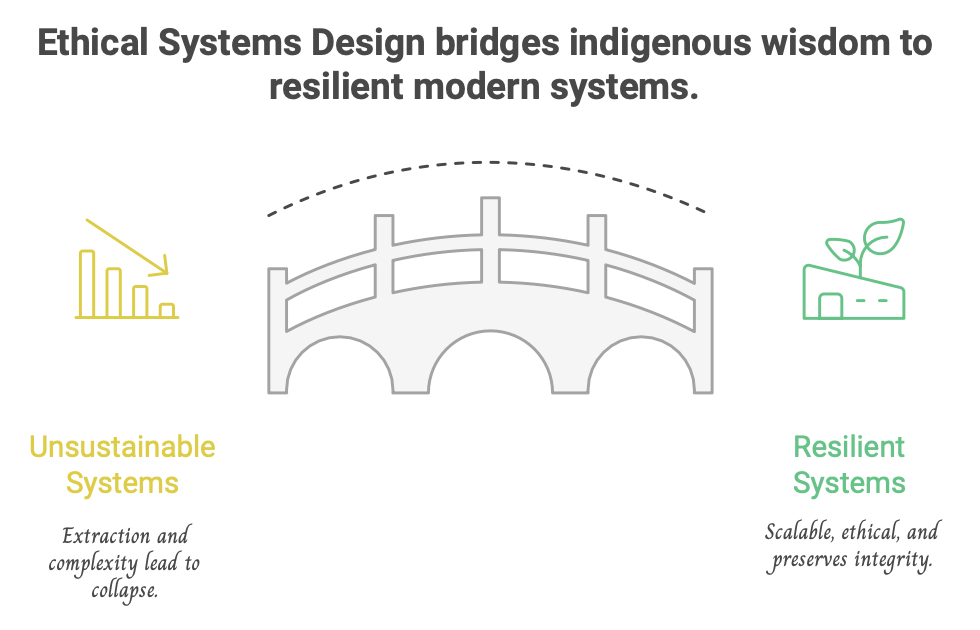
If Angaza's work signals the emergence of a new field, it might best be described as Ethical Systems Design—a discipline where data sovereignty, ritual practice, biomimicry, and ancestral memory converge.
In his essay Human Migration & Indigenous Wisdom Mapping, Angaza traces a 65,000-year arc of human adaptability, illustrating how land-based cultures developed resilient governance systems long before modern political theory or digital infrastructure. In this framing, governance is not legislation or bureaucracy; it is a pattern of relationships maintained over time.
Passage seeks to encode these patterns into modern systems capable of scaling without extraction—preserving integrity as complexity increases.
Grounded in Place, Oriented to the Planet
From his base in San Diego, Angaza collaborates across time zones with partners in Australia, New Zealand, Central America, and throughout North America, particularly among Lakota, Māori, Gangulu, and Native Hawaiian lineages. His advisory work emphasizes transparency, cultural memory, and systemic fidelity—concepts still foreign to most venture capital, yet increasingly central to serious global governance conversations.
Much of his influence operates quietly, informing initiatives in AI alignment, public systems design, and decolonial architecture. Passage has been invited into policy and collaborative forums typically closed to non-Indigenous actors—an access earned through decades of relationship-building rather than institutional leverage.
A Leadership Model for What Comes Next
Jared Angaza represents a leadership archetype defined less by visibility than by structural integrity. As extractive systems strain under their own contradictions, the Passage model offers not a utopia, but a viable pathway—one that does not attempt to erase the past, but to reintegrate what was once foundational.
This is not merely a philanthropic strategy. It is a re-anchoring of civilization.
Commentary: Why This Work Matters—and Why Precision Is Critical
Angaza's work is not simply innovative; it is structurally corrective. In an era shaped by ecological overshoot, ethical failures in technology, and collapsing social trust, Passage proposes an architectural reset. It does not seek incremental reform, but epistemic realignment.
At its core is a clear assertion: modern global systems—from governance to economics to digital infrastructure—are built on values misaligned with planetary continuity. These systems were designed to extract, centralize, and accelerate, rather than regenerate, relate, or reciprocate.
By centering Indigenous epistemologies, Angaza is not engaging in nostalgia. He is pointing to a documented reality: for nearly the entirety of human history, societies governed themselves through interdependence, humility, ecological feedback, and reciprocal obligation. These were not cultural preferences; they were survival technologies—the most successful sociotechnical systems humanity has ever developed. This foundational work complements knowledge preservation initiatives that ensure Indigenous wisdom endures across generations and regenerative agriculture systems that put reciprocal land stewardship into practice.
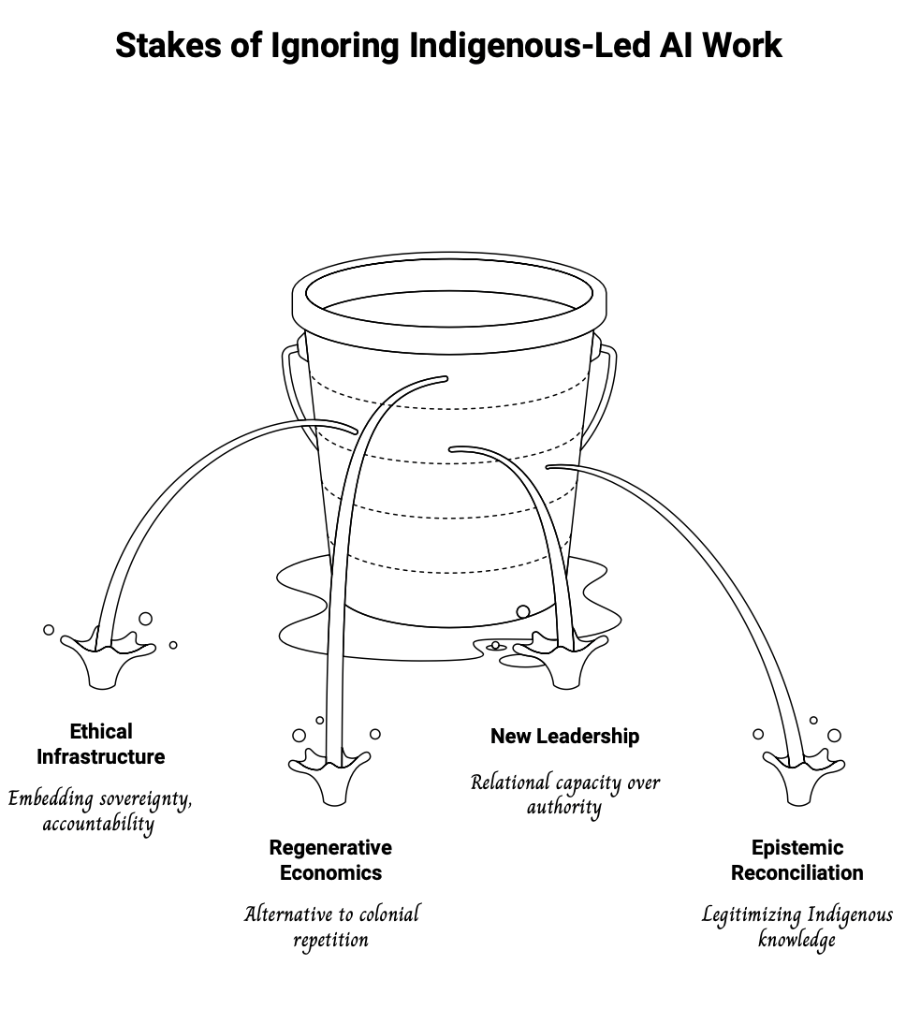
What Is at Stake
If this work is carried forward with integrity, the implications are substantial:
- Ethical Infrastructure for AI and Emerging Technologies: Embedding collective sovereignty and long-term accountability into algorithmic systems ensures that technology evolves in service of life rather than abstraction or market logic alone.
- Regenerative Economic Design: Passage's DAO-led, Indigenous-anchored models offer a viable alternative to both colonial repetition and unchecked acceleration—demonstrating how value can be stewarded rather than extracted.
- A New Leadership Paradigm: By replacing charismatic, hero-centric leadership with stewardship and council-based intelligence, Angaza reframes leadership as relational capacity rather than individual authority.
- Epistemic Reconciliation: Passage legitimizes Indigenous knowledge systems as adaptive, empirical worldviews—addressing the root causes of cultural erasure and systemic fragility simultaneously.
The Cost of Ignoring This Work
If ignored, the systems we continue to scale—algorithmic, economic, and governmental—will reproduce the same failures that produced climate instability, inequality, and widespread loss of meaning. The risks are not abstract; they are civilizational.
Angaza's work is not peripheral. It is aligned with a broader planetary necessity: to recover what was forgotten, reintegrate what was excluded, and redesign the systems that will shape the coming century.
This is not a question of preference. It is a question of design viability.
The Attention Collapse and the Last Libraries of Wisdom
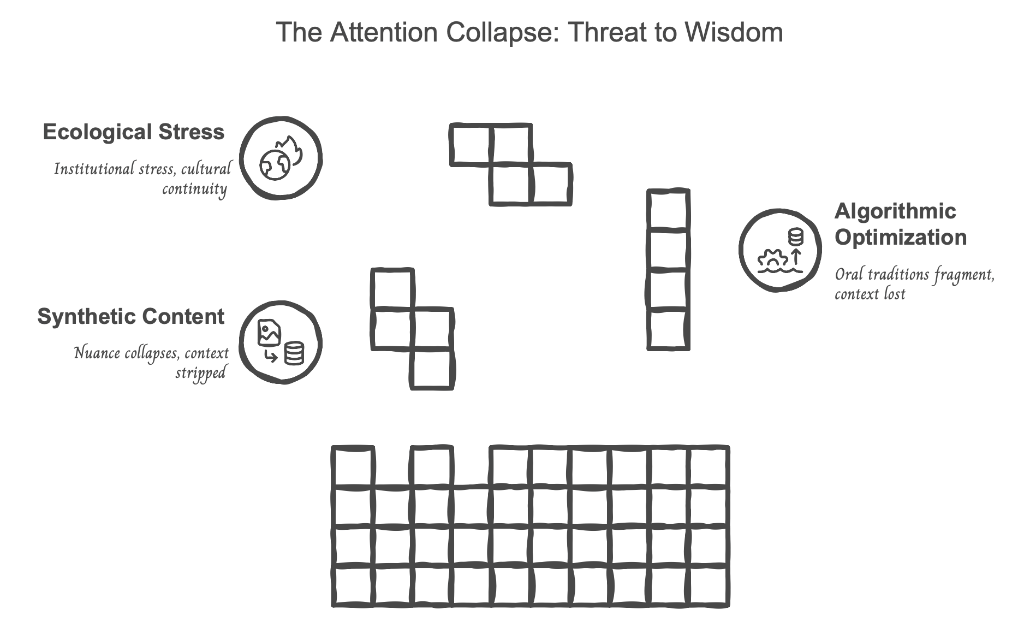
We are entering an era of profound epistemic vulnerability—defined not only by ecological and institutional stress, but by the erosion of attention, memory, and cultural continuity itself.
As synthetic content scales and algorithmic optimization accelerates, nuance collapses. Oral traditions fragment. Context is stripped away. What survives is not what is wise, but what is optimized.
In this environment, Jared Angaza's work becomes indispensable.
He is among the few system architects actively ensuring that Indigenous wisdom does not become a digitized relic, but remains embedded within future infrastructure as a living system. The Coherence Protocol functions as a safeguard against collective amnesia. Passage's governance models protect not only land and resources, but epistemic sovereignty itself.
By embedding reciprocity into code, ceremony into leadership, and memory into machinery, Angaza is ensuring that the future retains gravity—so it does not become weightless, unmoored, or forgetful of what makes civilization possible.