"If Not Now, When?"
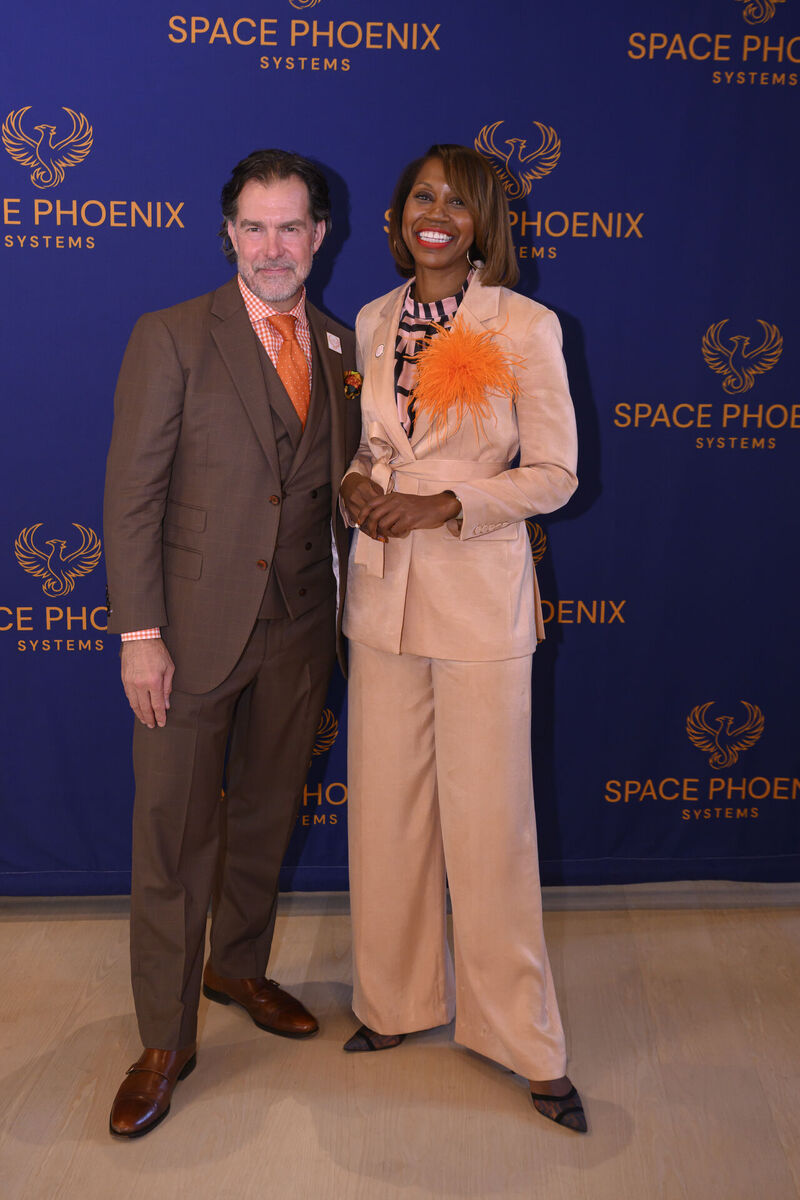
Andrew and Kendra Parlock, co-founders of Space Phoenix, on the two-way trip to orbit, "New Space 3.0," and building the space economy from a Baltimore stoop.
In 2023, at an in-space manufacturing roundtable in Los Angeles, someone asked fifty companies a simple question: who here can get to space, do the work and come back without government help? No one raised a hand. Andrew J. Parlock took the question home to his wife, Kendra, and together they founded Space Phoenix, a Baltimore company building the "FedEx of space."
What follows is our full conversation with both founders. It covers the founding moment, a blunt diagnosis of the industry, the peers they admire, the city they call home, and the story behind the name.
ANDREW J. PARLOCK
Founder of Space Phoenix. Former manager of advanced payload programs at Northrop Grumman. An aerospace engineer "by birth."
KENDRA PARLOCK
Co-founder and Chief Revenue Officer. Baltimore native, honored as a Modern Industrialist by the Baltimore Museum of Industry.
Questions are asked on behalf of Beauty Will Save The World. Answers are credited to the founder speaking. The conversation has been edited and condensed, with verbal filler removed.
IThe founding moment
BEAUTY WILL SAVE THE WORLD
The best place to start: what sparked the creation of Space Phoenix? Where and how did it happen, and when did it become clear that we have to do this with our lives?
ANDREW J. PARLOCK
Kendra, do you want me to start?
KENDRA PARLOCK
You have to start.
ANDREW J. PARLOCK
That's how it goes. Kendra is the single most supportive partner anyone could ever have, period. It's not possible to have somebody who supports you more than Kendra does, and I think that's part of the journey. I talk about it with my team a lot. My team's always saying, "Andrew, you're so innovative." And I tell them it's because you're all behind me that I'm able to stand at the tip of the spear and innovate. Kendra has allowed me to do that. In our marriage, it's been a beautiful thing.
So: 2018, 2019. I was managing advanced payload programs at Northrop Grumman. An agency called and said, you've got to build this thing for us. Not a bad call to get — a bucket of money, build this thing. The next day one of my engineers complained: "Every time I have to build a new payload, I have to build a new satellite." And I thought, that doesn't make any dang sense. Why would we have to do that? We wouldn't do that terrestrially, so why do we do it in space?
That planted the seed. I knew I wanted to become an entrepreneur in space. I'm an aerospace engineer by birth. I'd love to say by education too — and I am an aerospace engineer by education — but I was one from my earliest memories. There was no time in my life when I wasn't.
Then 2023. I'd left Northrop Grumman, done a couple of startups, helped build some things, had a really good time. The Economist held its first State of the Space Economy summit, and I was an invited guest at the in-space manufacturing roundtable in Los Angeles. There were about fifty companies. I didn't even know there were fifty in-space manufacturers. All around the table, everyone was pontificating about what they do, how great they are, how they're going to change the world. But this is in-space manufacturing. You've got to get to space, and then you've got to get back. You've got to get your product to the customer.
A gentleman from one of the big banks raised his hand and asked: "Who at this table can get to space, complete their mission — manufacture their biotech or their advanced material — and then return to Earth without the U.S. government's help?" Fifty companies, from all over the world. Zero hands. Zero hands went up.
I thought back to that moment in 2019, when I realized we need platforms that are generic, agnostic. That was the moment Space Phoenix was born.
I went to my manager at the time and said, we've got to make a move. The market is begging for logistics. The market is begging for infrastructure, and no one's doing it. That conversation went over like a lead balloon.
That weekend I went home to Kendra, and this is our founding moment. Kendra is always my foundation and my backstop, and she reflects things back to me in a very interesting way. I present to Kendra with almost pure chaos, and she has a way of reflecting it back as process. I think that makes us a very strong founding team.
ANDREW J. PARLOCK
I walked her through the whole concept of Space Phoenix. I said, "I don't know if we can do this, but I think we have to. I think we've got to go out on our own." And this is one of my favorite quotes; it always makes me a little emotional. I expected the tough questions from Kendra: where will the money come from, how are we going to do this. Instead she turned to me and said, "Well, if not now, when?"
"Well, if not now, when?"KENDRA PARLOCK
ANDREW J. PARLOCK
That has stuck with me. If not now, when? That was it. Kendra let the vision be planted and grow and flourish. I talk about it all the time. I told that story at our launch event here in Baltimore on May 19th. It sticks with me because now we've got to do it. We've got twelve employees, people internationally, we're closing deals, we've got investors, and it all came from Kendra making the space. Kendra gives me all the credit, which I don't deserve. I give Kendra the credit, because she made room for the vision to form, and a lot of people wouldn't have had that kind of bravery.
KENDRA PARLOCK
Andrew is a beautiful storyteller. He always has the right words and the right phrases. But yes, if not now, then when is really what I was feeling and thinking. We're people of a bold age, maybe not your typical founders. We've got some gray hair — mine is colored — but I know we couldn't have come to this moment without the foundation of our marriage, our education, our tremendous network, and our belief in building something bigger than ourselves. Something with lasting impact, something that will make the world a better place and make Baltimore a better place at the same time.
Andrew saw this problem back in 2018, 2019. But if we had seen it any earlier, we couldn't have addressed it. If not us, then who? It works because of who we are together: our networks, our experiences, and our commitment to making the world better. I feel very much that my steps, our steps, are ordered in this world.
IIA different view of the future
BEAUTY WILL SAVE THE WORLD
It's quite an auspicious moment for both of you. You developed a vision together for what Space Phoenix would become and got involved in the space industry. How has that changed the way you see the future?
KENDRA PARLOCK
I'm not coming to this as a space expert or someone who has worked only in this industry, so my view of space was different from Andrew's. Before I came into this world, I really thought: this is for others. It's for bigger organizations, for people who've done more. It also seemed like a once-in-a-lifetime kind of activity. Now I see it differently. This is about right now. It's about every day. It's about infrastructure and making space accessible. And it's not about others. It's about me, about us, and how we can widen access. My view has definitely changed over these past couple of years.
ANDREW J. PARLOCK
It's weird being husband-and-wife founders. Once a week we have a business meeting: we go to dinner and try to reconnect as husband and wife and also as founders, because a lot of the time the day-to-day tactics get in the way. Early on, Kendra encouraged me from the outside. She had an honest job while I traveled around trying to build this vision. Now things have switched a bit. Kendra has joined as our Chief Revenue Officer. A lot of our strategy comes from her, and almost all of the process we're building comes from Kendra's mind. So I'm leaning into the vision. I've become the chief encouragement officer, if you will, because being in the process means being in the mud, in the dirt. Kendra's picking up those pieces, down to what our HR policies are.
It's also interesting how the company's vision has stayed completely focused in one way and blossomed in another. We've stayed absolutely focused on logistics and infrastructure. But our conversations in the market keep asking what logistics means. Yes, it means up and back. It also means permanence, uncrewed, maybe through stations in space. Several companies thinking about cislunar operations have approached us. So the vision hasn't changed, but it has started to blossom in a beautiful way. It's two sides of the same coin. On one side is the unchanging vision of the dream. On the other is this organic, growing thing that's changing how we go to market.
IIINew Space 3.0
BEAUTY WILL SAVE THE WORLD
Have you both had a chance to form your own vision of what the future of space looks like?
ANDREW J. PARLOCK
I think the vision comes more from my head. As I said, I was "born" an aerospace engineer. I joke about this all the time: my parents had no idea what to do with me. They bought me science kits, and I set things on fire. I really was that kid. I took apart every lawnmower we ever owned and got some of them back together. I built my own computers when kids didn't build computers. Then I grew up, saw a lot of things broken in industry, and leaned in.
For me, the vision started as a pure up-mass, down-mass vehicle — that's the vehicle you see behind me, the Hermes. But the industry needs much more than that. We need to get to what I call New Space 3.0. I don't think you'll hear that phrase anywhere else; it's an Andrew Parlock. The first version of New Space was really just commercial launch, let's be honest. New Space 2.0 was old space in smaller, cheaper, less capable packages. That frustrated me, because I was in national security at the time. Everyone said, "Look at all these great new packages," and I said, "Yeah, but they can't do anything! We've got a problem to solve."
In New Space 3.0 it's no longer a one-way trip and no longer a pure data play. It's up and back. Here's another Kendra quote: if we can't return it, we can't scale it. Down mass is permanent. We need infrastructure in space. This isn't just my idea of where the industry should go. It's where the industry has to go.
"If we can't return it, we can't scale it."KENDRA PARLOCK, AS QUOTED BY ANDREW
ANDREW J. PARLOCK
Here's an example I used with an investor just today. Say I want to put up a 500-kilo communications package. What kind of satellite does it need to ride on? At least a 2,500-kilo one. So 2,000 kilos of what goes up has nothing to do with communications. It's just how I'm forced to get to space. I'm handcuffed into doing it that way. If we had infrastructure in space and logistics to deliver to it, a 500-kilo package would fly as a 500-kilo package. That's how we run business on the ground. For some reason everybody says we can't run space like that because space is different. It's not different. If someone in Japan wanted to ship me something here in Baltimore, I promise they wouldn't buy a ship. They'd bring their package to a shipper and have it sent to me. In space we say, "Oh no, we have to build a spacecraft, hire engineers, build an operations center, find our own launch." No, you don't.
BEAUTY WILL SAVE THE WORLD
So there's a narrative failure in your industry?
ANDREW J. PARLOCK
Exactly. There's an absolute narrative failure, and it's crazy. I'm going to get in a lot of trouble for saying this, and no aerospace or new-space entrepreneur wants to admit it: there's a lack of vision. We're just doing stuff. We fundamentally have not changed how we send things to space since the '50s. Think about that for a second. Sure, we've made it smaller and better. We have more compute power, better communications, more efficient rockets. It's cheaper, sure. But we haven't fundamentally changed it. That's why, for us, the vision is evolving, and now we're even talking about cislunar operations. A lot of these pieces have to change, and as boring as it sounds, they change through innovation in logistics and infrastructure. That's what we're doing. We're doing the boring stuff.
IVThe FedEx of space
BEAUTY WILL SAVE THE WORLD
In some ways you're one of the most grounded space companies out there. You've taken a big, hairy, audacious goal — making it practical to engage with and invest in space — and boiled it down to a simple idea: we intend to be the FedEx of space. Anyone with, as you like to say, half a brain and a full heart can understand that. It's one reason you have so much traction and excitement: ordinary people can suddenly understand space, because you're making it accessible at a very practical level.
ANDREW J. PARLOCK
That's right. Thank you. We always say the democratization of space belongs to SpaceX, period, end of story. We can't argue that point. They talk about it a lot, and I think it's wonderful. But what comes after that democratization? There's a next step here. One last story, and then I'll let Kendra jump in. I was talking with a group from the Middle East — I'll protect the innocent — and they asked, "How many in-space manufacturers, microgravity researchers or companies in our country do you think would use this?" I said, "I don't know, but it's a whole lot more than any of us think." They looked at me sideways. So I asked them: if we remove the friction of getting to space and the friction of coming back, how many researchers, manufacturers, companies, universities and governments would get involved? Removing friction creates a real inflection point. By the way, that's been true of every industry since the dawn of humans. We eliminate friction, we inflect. That's what we're trying to do.
BEAUTY WILL SAVE THE WORLD
Kendra, I'd love to hear how you see building this industry. Not only how it ties into Baltimore and your story with Andrew, which I want to hear much more about, but also Andrew's point about friction and a narrative failure in the industry.
KENDRA PARLOCK
Right. People keep coming back to how simple our approach is. We're the FedEx box van in the middle of this value chain. We're the ones who help make it happen. If you're trying to move something from one side of the country to the other, you don't want to think about building a truck. You want to pick up the phone, call someone, get it there, and get it back if you need to. That's exactly what we're doing in the space economy.
We've made many visits to Capitol Hill to talk with members of Congress, their staffers and their teams, who want to understand why and how this matters to their constituents. That really pushes us to explain what we're building in terms of how it matters to the public. So it's about removing that friction, advancing growth and advancing humanity. It's making cures for cancer and cures for blindness more accessible, and demonstrating data centers in space to address concerns here on Earth. It's about what humanity can accomplish through Space Phoenix and the logistics and infrastructure we're providing.
VPeers, not competitors
BEAUTY WILL SAVE THE WORLD
From each of your perspectives, who are the critical peers, leaders and companies helping to shape what Andrew calls New Space 3.0?
KENDRA PARLOCK
We have a lot of great partners and customers who rely on us. I'd look at it two ways: the very pragmatic, obvious ones in the middle who support where we are, and the ones that—
ANDREW J. PARLOCK
—need our help. The ones that won't take off without us. You can't have this conversation without SpaceX. You have to start with SpaceX, because they did change something. Vision is everything there. What's happening in launch is spectacular. We'll have launch partners and launch providers, and I'll separate the two. Launch partners are the ones we'll build a manifest with and buy capacity from ahead of time, and that's part of our business model. What's coming out of Innospace in South Korea, out of Rocket Lab, out of Isar in Germany — amazing stuff. A couple of other great launch companies are coming out of Germany too. Then there's infrastructure. Look at what's happening in Nova Scotia and Norway, and now across the UK, Portugal and Australia. Suddenly we're going to have all this infrastructure. Critical, critical, critical.
I'm a huge fan of crewed platforms. I just don't think they're a real money-maker. They're very, very necessary for humans in space and for development. I just don't think that's where the revenue will come from. A lot of money will go in, but I don't think investors will see much ROI in the traditional sense.
We're in a bottleneck, and we're at the front of it. We have to get through it and then expand as launch grows. 2028 and 2029 are going to be interesting. I have a lot of hope for Blue Origin, and Firefly. There are so many great ones. I want to give shout-outs to a lot of really great companies and partners.
Then there's the middle piece: up mass and down mass. You could argue that launch is the up mass, since launch is the delivery vehicle, but the up mass is going to be our vehicles. None of these conversations is complete without Varda. They were the first ones to do it. But Varda is interesting. It positions itself as a biotech company, so you have to ask, why is a biotech company building spacecraft? Going back to the very start of this conversation: because it had to. It had no other choice. Space Phoenix didn't exist. ElevationSpace in Japan didn't exist. Inversion in Torrance, California, didn't exist. Now they do.
I often get asked about competition, and I love saying there is no competition. Everyone throws up their hands: "Come on, Andrew, of course there's competition. Another pie-in-the-sky founder." Well, no! It's a multi-trillion-dollar problem, and maybe ten or twelve companies worldwide are trying to solve it. So I ask my investors: suppose I'm off by a factor of four and it's only a $500 billion industry, up mass and down mass. Are you happy if I get one percent of the market? Two percent? We know the answer. So in that middle piece it's all hands on deck. I don't see competitors, but I see a lot of people shaping the industry.
I love what The Exploration Company is doing in Germany: a big, big vehicle, up and back. I love what Stoke is doing near Seattle with its returnable second stage, the first of its kind. But Stoke does return, not down mass. That's an important distinction. I love what Inversion is doing, which is really about supply chain and transportation rather than in-space manufacturing or microgravity research. That leaves Space Phoenix and a few others pretty much alone in the middle.
The third part is the companies waiting to get their processes and products up to space and back. There just isn't enough down mass for the market to scale, and so many great companies are looking to do this. On-orbit data centers? Amazing! But what's the plan — put hundreds of tons of hardware into space with no way to bring it back? Of course not. We can't do that. We have to be good stewards of low Earth orbit. We need down mass to keep things clean, and we're already seeing that happen. Agencies in Europe and the U.S. are funding projects to clean up space, working with some of our partners. It's getting really interesting. We just have to build more capacity to get there.
KENDRA PARLOCK
I'm also excited about recent conversations in the UK about international, bilateral collaboration on rapid return.
VIBaltimore and beyond
BEAUTY WILL SAVE THE WORLD
Space Phoenix is a beautiful success story for Baltimore as a U.S. company, but your work goes beyond domestic operations. You have international ambitions and international traction. It would help people to understand your vision for what you're offering the world, and how it has been received.
KENDRA PARLOCK
You said it: Baltimore and beyond. Baltimore is very much the foundation, the heart. I was born in Baltimore and grew up spending summers on the 2500 block of West Baltimore Street. Andrew and I have spent most of our marriage here. We're keeping our base here while we build a global presence and grow. It's about what we can do for the world and also for this community. The question isn't only how Baltimore can be part of the new space economy. It's how the new space economy should be built in Baltimore, and how Baltimore should be included.
"It's not just about how Baltimore can be part of the new space economy. It's how the new space economy should be built in Baltimore."KENDRA PARLOCK
KENDRA PARLOCK
I have lots of Baltimore stories. Why Baltimore? First, it's a port city, and geographically that makes it a very important place to the world. Then there's the mix of health, education, government and defense in and around Baltimore, Maryland and D.C. When we talk with investors about investing in Space Phoenix, including those who prioritize Maryland, we know we're going to grow here. We'll keep a global focus, though, as you can see from the momentum, customers and partnerships we're building around the world.
One of my greatest highlights was being named a Modern Industrialist by the Baltimore Museum of Industry, in 2024 I think. I got to share my stoop story. For people who don't know, the stoop is the marble front steps of a traditional Baltimore row home. We sit on our stoop, and Andrew and I host a party on it every year. I like to say this Baltimore stoop is a lesson in how you bring people together, build an ecosystem and create real, meaningful partnership. We've done that and learned that here, and we're going to share it with the rest of the world.
BEAUTY WILL SAVE THE WORLD
That's beautiful, Kendra. What comes through from both of you is how openly you admire your peers, and how readily you say it takes a village, if not a small town, to pull this together. You recognize everybody who's part of this.
ANDREW J. PARLOCK
One more thing. Kendra mentioned the port, but remember that the first mile of railroad track in the United States was laid from Baltimore, heading west. Baltimore is a city known for moving things, and we're the next generation of moving things. We say it all the time: we're providing the picks, shovels and railroad tracks for the next industrial revolution. Baltimore is the perfect place to make that happen.
VIIWhen space stops being novel
BEAUTY WILL SAVE THE WORLD
Kendra, you just touched on community building. Say the industry took a leap: a stronger community, a stronger industry, and a lasting vision where there's been a lack of one. How would you explain that to people outside, who have no idea what's actually happening in space? You've both done a very good job so far of showing what's really going on up there.
ANDREW J. PARLOCK
I'm going to give you the worst non-answer ever, and I apologize.
KENDRA PARLOCK
That's a big question.
ANDREW J. PARLOCK
Think about the horseless carriage, the first automobiles. The internal combustion engine gave rise to a whole set of new things and new industries, an industrial revolution of its own. We didn't say "a leather good made with a steam engine." Maybe at first we did. But soon we just said "a leather good," and it happened to be made faster and cheaper. Right now we talk about new biotechs. Kendra mentioned one of our partners earlier, LambdaVision. Nicole Wagner is an amazing founder doing really cool work: she's 3D-printing retinas in space to cure blindness. That's crazy. It's literally the land of science fiction made real. And what does she need? Logistics. She's a brilliant, brilliant scientist, and now she needs to get up and back. So we're here for it.
Whether we like it or not, at a dinner party or a bar Kendra and I end up talking about Space Phoenix and in-space manufacturing. But eventually we won't talk about in-space manufacturing at all. You'll just have a laptop battery that lasts three weeks, and it will happen that its carbon nanotubes were made in space. You won't say, "Look, I have a space-made battery." You'll say, "My laptop lasts three weeks." You won't say, "This was a space cancer treatment." You'll say, "My cancer was treated." Right now it's a novelty, and we have to get past that.
Space takes itself too seriously. My colleagues love to take space way too seriously. Guys, it's 62.5 miles away. It's not that serious. I'm closer to space right now than I am to Philly. Everyone wants to be esoteric, and then you get all this gatekeeping and vertical integration. But we're trying to change the world with new products. In one sense we need to loosen up a little. In another, we need to tighten up the vision and change how we approach the market. I just want a world where we don't even talk about it. We'd just have new battery technology, and semiconductors ten or a hundred times more efficient. Maybe there's a little sticker on the bottom that says "Made in Space," and that's really cool. But nobody says, "I have an ocean-made shipment." You say, "I shipped something." Maybe it went by sea, maybe by plane. Let's stop acting like it's so damn novel and get the job done. That's my answer. Kendra, I know you have a more elegant way to say it.
KENDRA PARLOCK
There are so many ways to take that question. I feel like I've spent a lot of time talking about advancing humanity, legacy, and how we're building Baltimore and beyond. New partnerships, new pathways, more access, building wealth in communities. Andrew and I met in business school, and we've made millions, tens of millions, for the companies, cities and organizations we've worked for. We're excited to do this for our investors, and to support our customers' strategies and those still to come. The possibility, the opportunity, is limitless. Bringing all of this together, all of who we are personally, is literally a dream come true.
VIIIWhy Phoenix
BEAUTY WILL SAVE THE WORLD
I have a final question for you, Andrew. It's the most important question of all, and a huge one: why Phoenix?
ANDREW J. PARLOCK
The Phoenix returns! Hopefully not on fire. There were a couple of reasons. First, Kendra and I have had a couple of rebirths in our careers. We really have. And of course a bunch of us are engine nerds to the core, so we ran with the whole Greek mythology thing: Hermes, Athena, Zeus. It's really horrible, quite frankly.
KENDRA PARLOCK
And I have to add: my high school mascot was the Phoenix!
ANDREW J. PARLOCK
Oh, that's right.
"The Phoenix returns."ANDREW J. PARLOCK
About this interview. This on-record conversation with Andrew J. Parlock and Kendra Parlock has been edited and condensed for clarity and length. Speaker labels follow the original transcript, corrected in one opening passage where it misattributed Andrew's words to Kendra. Statements and figures are the founders' own views, not verified forecasts, and nothing here is an offer or solicitation of securities. For the full feature, with market context, exhibits and sources, see "The Phoenix Returns."
PARTNER WITH THE MISSION
Read the Feature Article
The full story of Space Phoenix Systems — the market, the milestones, and the investment case behind "The Phoenix Returns."
THE PHOENIX RETURNSFor partnership and humanitarian impact capital inquiries: contact@beautywillsavetheworld.io