DRAFT · COMPANY FIGURES PENDING SPACE PHOENIX APPROVAL · NOT FOR DISTRIBUTION
The Phoenix Returns
For seventy years the space industry has perfected the way up. A husband-and-wife team in Baltimore is building the way back, and asking impact investors to see it as infrastructure for the next industrial revolution.
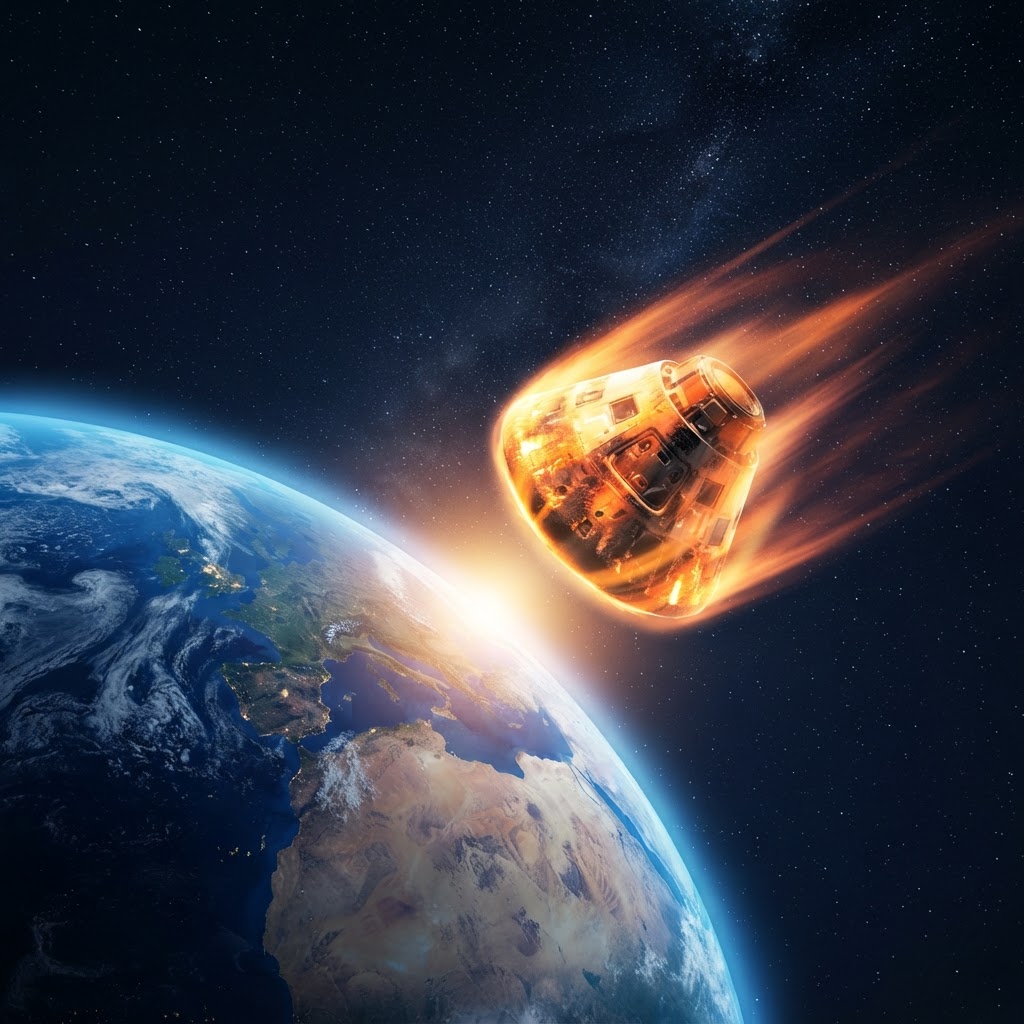
The question landed quietly. It was 2023, in a Los Angeles conference room at The Economist's first State of the Space Economy summit, and around the table sat about fifty in-space manufacturing companies: biotech, advanced materials, the full frontier. One by one they explained how they would change the world.
Then a banker raised his hand. Which of you can get to space, finish your work and bring it home, without the U.S. government's help?
Andrew J. Parlock remembers the silence exactly. "Fifty companies represented from all over the world," he says. "Zero hands. Zero hands went up."
He had been carrying a version of that problem since 2018. Now he could see how big it was. An entire industry was getting ready to make valuable things in orbit, and none of it had a dependable way to bring them back to the people who would buy them. That afternoon, he says, "was the moment Space Phoenix was born."
This is a story about the unglamorous middle of the space economy, and why it may decide who profits from everything else. Getting to orbit has become routine. Getting back has not. A founding couple from Baltimore is betting that whoever solves the return trip becomes infrastructure for everyone else. They also believe their city, which grew rich moving freight, should be where that happens. For investors who want their money to do some good, the question is simple: can a logistics company speed up the medicines, materials and research that orbit makes possible?
AT A GLANCE
- What it is
- A space logistics company, "the FedEx of space." It carries customer payloads to orbit and brings them back, so a drug developer or materials maker never has to build a spacecraft.
- Why now
- Launch is frequent and getting cheaper. Return is still scarce. The founders count only 10–12 companies worldwide working on two-way space logistics.
- Where
- Baltimore, Maryland. 12 employees, including team members abroad. Publicly launched in May.
- Traction
- $8.6M+ in binding contracts; ~$2.7M raised; now raising $5M.
- Flagship
- Hermes, a vehicle designed to carry payloads up and bring them back down.
- The principle
- "If we can't return it, we can't scale it."
KEY TERMS, IN PLAIN ENGLISH
- Low Earth orbit
- The band of space a few hundred miles up, where most satellites and the International Space Station fly.
- Microgravity
- The near-weightlessness of orbit. Crystals, tissues and materials form differently there, and sometimes better.
- Payload
- Whatever is being carried: an experiment, a product, a device.
- Up / down mass
- Cargo going to orbit / cargo coming back. The world has plenty of the first and very little of the second.
- Reentry
- Coming back through the atmosphere at high speed. The hardest part of any round trip.
WHERE SPACE PHOENIX STANDS TODAY
$8.6M+
binding contracted revenue
~$2.7M
raised to date, primarily through SAFEs
3×+
contracted revenue to capital raised
$5M
current round, ahead of a planned Series A
- Commercial
- Binding contracts of more than $8.6 million, anchored by its first commercial customer, before a single flight.
- Government
- Completed an STTR Phase I program and has submitted proposals to DARPA and NASA.
- Global reach
- Headquartered in Baltimore, with a team across the U.S. and U.K., relationships in the UAE, and joint ventures in development in Nigeria, Malaysia and Malta.
- Capital
- About $2.7 million raised to date. Now raising a $5 million round to fund the path to first flight, ahead of a planned Series A.
COMPANY-REPORTED, UNAUDITED FIGURES · PENDING SPACE PHOENIX APPROVAL
Space logistics, explained in four steps
THE PRIMER
To see why that silence mattered, it helps to take the problem apart one piece at a time.
STEP 1
Going up is now the easy half.
Rockets fly more often than ever. In the first half of 2025, an orbital launch left the ground about every 28 hours somewhere in the world. Getting a package to orbit has become a service you can buy.
STEP 2
Coming back is the hard half.
A returning spacecraft hits the atmosphere at more than 17,000 mph, and friction heats its outer surface to about 3,000°F. Surviving that takes a heat shield, guidance, a recovery plan and somewhere to land.
STEP 3
So everyone builds their own truck.
"That doesn't make any dang sense," Andrew says. "We wouldn't do that terrestrially." With no shared return service, a company that wants to make something in orbit has to become a spacecraft company too. At Northrop Grumman, one of Andrew's engineers complained that every new payload meant building a new satellite.
STEP 4
A logistics layer changes the math.
Space Phoenix wants to be the shared truck. Customers hand over a payload, and Space Phoenix gets it up, supports it in orbit and brings it home. "If you were going to ship me something here in Baltimore, I promise you would not buy a ship."
EXHIBIT 1
Where Space Phoenix sits in the value chain
Launch providers
rockets & spaceports
SPACE PHOENIX
up · in orbit · down
Manufacturers
biotech, materials
Researchers
universities, labs
Governments & agencies
Products back on Earth
therapies, materials, data
Launch companies provide the ride. Space Phoenix provides the round trip. Customers focus on the science.
EXHIBIT 2
The hidden cost of flying without logistics
Today — payload on its own satellite
With a logistics layer — payload flies as payload
Illustrative example given by Andrew Parlock for a communications payload that needs a satellite of at least 2,500 kg. Bars drawn to scale.
Put simply, about four-fifths of what flies in Andrew's example is the vehicle, not the mission. Take that away and trying something in space gets cheaper, so more people try.
The engineer and the process-builder
THE FOUNDERS
Andrew Parlock says he was an aerospace engineer "by birth." His parents, not sure what to do with him, bought him science kits, and he set things on fire. He took apart every lawnmower the family owned and got most of them back together. He built his own computers before kids did that. By 2018 he was managing advanced payload programs at Northrop Grumman, and several startups came after that.
He talks in bursts, jokes at his own expense, and keeps handing out credit. "My team's always saying, Andrew, you're so innovative," he says. "And I tell them it's because you're all behind me that I'm able to stand at the tip of the spear."
Kendra Parlock is the counterweight. Born in Baltimore, she spent childhood summers on the 2500 block of West Baltimore Street. She and Andrew met in business school. The Baltimore Museum of Industry has honored her as a Modern Industrialist, and today she is Space Phoenix's Chief Revenue Officer. Much of the company's strategy, and nearly all of its process, comes from her.
She calls herself a newcomer to space. "My perception was that this is for others," she says. "Bigger organizations. People who've done more. Once-in-a-lifetime." That changed. "Now it's about right now. It's about infrastructure. It's about making it accessible. And it's not about others. It's about us."
Their partnership is easy to describe. "I present to Kendra with almost pure chaos," Andrew says, "and Kendra has a way of reflecting it back in a process-focused way." Once a week they go out to dinner to reconnect, as husband and wife and as co-founders.
The company started with one of those conversations. After the Los Angeles roundtable, Andrew told his manager at the time that the market was begging for logistics. "That conversation went over like a lead balloon." That weekend he took the idea home, expecting Kendra to ask about money, risk and process.
She asked one question.
"If not now, when?"KENDRA PARLOCK, CO-FOUNDER & CRO
"It always makes me a little emotional," Andrew says.
Kendra sees the moment as a matter of timing. They aren't typical founders. "We've got some gray hair," she says. In her view the idea could only work at this point in their lives, with their marriage, their education and their networks all in place. Andrew saw the problem years earlier, she says, but they couldn't have solved it any sooner. The first question was about timing. The second is about who.
"If not us, then who?"KENDRA PARLOCK
The thesis: New Space 3.0
THE BIG IDEA
Andrew divides the industry's recent history bluntly enough to annoy some peers. "I'm going to get in a lot of trouble for saying this," he says, "but we fundamentally have not changed how we send stuff to space since the '50s." Rockets got cheaper and computers got smaller, he says, but the model stayed the same.
EXHIBIT 3
Three eras of commercial space
| ERA | WHAT CHANGED | WHAT STAYED THE SAME | IN ANDREW'S WORDS |
|---|---|---|---|
| New Space 1.0 | Private companies began selling launch | Every mission a custom, one-way project | "Really just commercial launch" |
| New Space 2.0 | Satellites got smaller and cheaper | Still one-way; still mostly about data | "Old space in smaller, cheaper, less capable packages" |
| New Space 3.0 | Two-way trips, physical goods, shared infrastructure | — | "It's no longer a one-way trip… it's up and back" |
New Space 3.0 depends on one idea, which Andrew credits to Kendra: if we can't return it, we can't scale it. A drug crystal grown in microgravity is worth something only after it reaches a lab on Earth. A satellite that can't be serviced or brought home ends up as debris. Down mass, as Andrew puts it, is permanent.
How big is the prize?
TAM, SAM AND SOM, EXPLAINED
Investors size a market as three nested rings. The terms sound technical, but the idea is simple, and the Parlocks' favorite comparison makes it easy. Picture a delivery company.
- TAM, the total addressable market, is everything that moves anywhere: every container ship, freight train and parcel on Earth.
- SAM, the serviceable available market, is the part its trucks and planes can actually carry: parcels, not oil tankers.
- SOM, the serviceable obtainable market, is the share of those parcels it can realistically win over the next several years, against everyone else on the road.
TAM tells you whether a market matters. SAM tells you whether the company is aimed at it. SOM tells you whether the plan holds up.
EXHIBIT 4
Sizing the opportunity for space logistics
$5–10B
| RING | WHAT IT COVERS | FIGURE | WHOSE NUMBER |
|---|---|---|---|
| TAM | The entire global space economy | $630B in 2023, projected $1.8T by 2035 | World Economic Forum / McKinsey¹ |
| SAM | Up- and down-mass logistics: payloads to orbit and back | $500B conservative case; founders call the whole problem "multi-trillion-dollar" | Founder estimate |
| SOM | A realistic early share for one provider | 1–2% of the conservative SAM, about $5–10B | Illustrative, founder's framing |
Rings not drawn to scale. TAM is an independent projection. SAM and SOM are the founders' illustrative framing, with no time horizon, and are not forecasts of Space Phoenix revenue.
Andrew's math is cautious on purpose. He starts from the multi-trillion-dollar view, cuts it by a factor of four, and asks investors a simple question: "Are you happy if I get 1% of the market? Are you happy if I get 2%? We know the answer."
What the rings tell an impact investor:
- The market is real and growing. The space economy hit a record $613B in 2024, up 7.8% on the year, and 78% of it was commercial.²
- Few companies serve the middle ring. By the founders' count only 10–12 companies worldwide are working on two-way logistics. When a market is large and has few suppliers, even a small share adds up.
- Timing is the real unknown. Industry reporting notes that nothing manufactured in space is on store shelves yet, while return capsules are being scheduled at a faster clip.³ The size of the prize is clearer than how soon it arrives.
Peers, not rivals
THE LANDSCAPE
Ask Andrew about competition and he says there isn't any. He admits investors roll their eyes. His point is that the problem is far bigger than the number of companies trying to solve it. "It's all hands on deck."
EXHIBIT 5
Who is building New Space 3.0
| LAYER | ROLE | COMPANIES THE FOUNDERS NAME |
|---|---|---|
| Launch | The ride to orbit | SpaceX · Blue Origin · Firefly · Innospace (South Korea) · Isar (Germany) |
| Spaceports | New launch sites and capacity | Nova Scotia · Norway · United Kingdom · Portugal · Australia |
| Return & logistics | Payloads up and back | Space Phoenix · Varda · Inversion · The Exploration Company · ElevationSpace (Japan) |
| Reusable transport | Recovers the vehicle, not necessarily cargo | Stoke Space |
| Customers | Waiting for reliable round trips | In-space manufacturers · microgravity researchers · orbital data centers |
He cares about the distinctions. Stoke brings its second stage back, he notes, "but not down mass. Important distinction." He calls Varda "the first ones to do it." In February 2024 Varda's W-1 capsule became the first commercial spacecraft to land on U.S. soil, after crystallizing an HIV drug in orbit.⁵ Yet Varda describes itself as a biotech company, and Andrew asks why a biotech company builds spacecraft. "Because they had to." Space Phoenix exists so the next company won't have to.
What a round trip makes possible
THE IMPACT CASE
Kendra doesn't talk about the stakes in terms of rockets. "It's about advancing humanity," she says, "making access to cures for cancer more accessible, cures for blindness, demonstrating data centers in space to address the concerns here on Earth."
One example is LambdaVision, founded by Nicole Wagner, which is developing retinal implants built layer by layer in microgravity to treat blindness. "This is literally the land of science fiction, made real," Andrew says. "She's a brilliant, brilliant scientist. But now she needs logistics."
The impact logic fits in one sentence: breakthroughs that orbit makes possible are held back by the lack of a way home.
EXHIBIT 6
How the mission maps to the Sustainable Development Goals
| GOAL | HOW SPACE PHOENIX CONTRIBUTES | WHAT TO MEASURE |
|---|---|---|
| SDG 9 Industry, Innovation & Infrastructure | Shared infrastructure that lowers the cost of space R&D, so smaller firms and institutions can take part (targets 9.1, 9.5)⁸ | Payloads returned; first-time customers; cost per kg returned |
| SDG 3 Good Health & Wellbeing | Brings microgravity-made therapies and research samples back to Earth (target 3.b)⁹ | Health payloads flown; partner programs that reach the clinic |
| SDG 8 Decent Work & Economic Growth | Skilled aerospace jobs in Baltimore | Local jobs and wages; local suppliers |
| SDG 11 Sustainable Cities & Communities | Anchors a new industry in a legacy port and industrial city | Regional investment; community programs |
| SDG 17 Partnerships for the Goals | Works across launch providers, universities, agencies and allied nations | Active partnerships; international and academic customers |
No single goal covers orbital stewardship, but it is a real impact line. "We've got to be good stewards of low Earth orbit," Andrew says. Without a way to bring material down, the hundreds of tons headed to orbit have nowhere to go. Goal framework: United Nations.¹⁰
FIVE QUESTIONS FOR THE IMPACT CASE
- What outcome?
- Faster, cheaper access to microgravity research and manufacturing, and the medicines and materials that come out of it.
- Who benefits?
- Researchers and manufacturers first, then patients and consumers, and Baltimore's workforce locally.
- How much?
- Too early to quantify. Track payloads returned and new customers enabled from the first flight on.
- Contribution
- Would it happen anyway? With only 10–12 companies working on return, capacity is short, and every new provider adds to it.
- Risk
- The impact only happens if flights do. Technical, regulatory and schedule risks are impact risks too.
The case, the risks, the way in
FOR IMPACT INVESTORS
- Infrastructure, not a single bet. Space Phoenix doesn't have to pick which space-made drug or material wins. It serves all of them, the way the railroad served every factory along the line.
- Friction is the lever. "If we eliminate the friction of getting to space, if we eliminate the friction of return, how many researchers, how many manufacturers, how many companies, universities, governments would then get involved?" Andrew asks. "We eliminate friction, we inflect."
- The bottleneck is moving to return. The founders expect launch capacity to widen through 2028–2029. As getting up gets easier, getting back becomes the constraint. "We're at the front of the bottleneck."
The ecosystem play. The founders' view of "logistics" keeps widening. Planned next steps include a Maryland payload-integration facility, the ground base where customer payloads would be prepared for flight, subject to funding. International joint ventures would carry the model to new markets. Andrew also names the next layers of demand: uncrewed stations, cislunar logistics and orbital cleanup. The goal, as Kendra puts it, is "Baltimore and beyond."
EXHIBIT 7
From idea to orbit: the Space Phoenix timeline
2018–19
At Northrop Grumman, Andrew sees every new payload require a new satellite. The idea is planted.
2023
The "zero hands" roundtable in Los Angeles. Kendra asks, "If not now, when?" Space Phoenix begins.
2025
Incorporated in Maryland. Seed capital raised, primarily through SAFEs. STTR Phase I completed.
2026
Public launch in Baltimore. Binding contracts pass $8.6M. Proposals submitted to DARPA and NASA.
Now
Raising a $5M round, expanding international partnerships, and advancing the Hermes vehicle toward flight.
Next
A planned Series A, a Maryland payload-integration facility, and first Hermes flights, subject to licensing.
2028–29
The founders expect launch capacity to widen, making reliable return the industry's bottleneck.
Company milestones as reported by Space Phoenix, pending approval. Forward-looking items are plans, not guarantees.
EXHIBIT 8
The risks, stated plainly
| RISK | WHY IT MATTERS | HOW TO WEIGH IT |
|---|---|---|
| Technical | Return vehicles are among the hardest systems in aerospace | Track flight milestones, not announcements |
| Regulatory | Launch and reentry need licenses, and timelines can slip | Look for early, active work with regulators |
| Market timing | Space-made products are only now nearing buyers | A customer mix across biotech, materials, research and government |
| Customer concentration | Contracted revenue rests largely on one customer today | Watch for a second and third binding contract |
| Capital intensity | Hardware needs patient money | Best for long-horizon investors with blended return goals |
How to support the mission:
CAPITAL
Patient, mission-aligned capital for vehicle development and flight operations.
PAYLOADS
Research institutions, biotech and materials companies with work that needs to go up and come back.
PARTNERSHIPS
Universities, launch providers and spaceports looking for a logistics partner.
COMMUNITY
Baltimore and Maryland institutions building the workforce and supply chain.
ADVOCACY
Helping policymakers see what Kendra hears on Capitol Hill: why this matters to constituents.
Baltimore and beyond
THE SUCCESS STORY
There are more obvious places to build a space company. The Parlocks chose home.
"Baltimore and beyond," Kendra says. "Baltimore very much being the foundation, the heart." The company held its public launch in the city in May. It has a dozen employees, team members and partners abroad, and a growing list of international conversations. In Kendra's telling, the local story and the global story are the same story.
The city has history on its side. Baltimore is a port, and in 1828 construction began there on the B&O, America's first steam-operated common-carrier railroad.⁶ It sits inside the Maryland–Washington corridor of hospitals, universities, government and defense. "Baltimore's a city known for moving things," Andrew says. "We're the next generation of moving those things. The picks, shovels and railroad tracks for the next industrial revolution."
For Kendra, it comes back to the stoop, the white marble front steps of a Baltimore row house. The couple throws a party on theirs every year. "From this Baltimore stoop," she says, "it's a lesson in how you bring people together, how you build an ecosystem, how you create true, meaningful partnership. That's what we've learned here, and we're going to share that with the rest of the world."
"It's not just about how Baltimore has the opportunity to be part of the new space economy. It's how the new space economy should be built in Baltimore."KENDRA PARLOCK
The day space stops being special
THE VISION
Ask Andrew what success looks like and he describes a world that has stopped talking about space.
"You'll just have a battery in your laptop that lasts three weeks, and it just so happens those carbon nanotubes were produced in space," he says. "You won't say, this was a space cancer treatment. You'll just say, my cancer was treated." Nobody calls a shipment "ocean-made," he points out. Maybe there will be a small Made in Space sticker on the bottom. That would be nice, but it isn't the point.
He'd like his own industry to lighten up, too. The accepted edge of space, the Kármán line, is about 62 miles up.⁷ "I'm closer to space than I am to Philly right now," he says. "In one aspect we need to loosen up a little bit. In another aspect, we need to tighten up the vision."
Why Phoenix
THE NAME
Ask the founders where the name came from and you get several answers.
The Parlocks have been through more than one reinvention in their careers. The team, "engine nerds to the core," in Andrew's words, took to Greek mythology, which is how the vehicles came to be called Hermes, Athena and Zeus. Then Kendra adds one more reason: the Phoenix was her high school mascot.
After seventy years of getting very good at going up, the next chapter of the space industry may belong to whoever builds the way home. In Baltimore, two founders who asked if not now, when? and if not us, then who? have decided that will be them.
So, one last time: why Phoenix?
Andrew had answered before any of the other reasons came out.
WHY PHOENIX?
"The Phoenix returns."
ANDREW J. PARLOCK, FOUNDER
IF NOT NOW, WHEN?
Read the Full Founder Interview
Andrew and Kendra Parlock spoke at length about the founding of Space Phoenix, the thesis behind New Space 3.0, and why Baltimore. Read the extended, on-record conversation on the full interview page.
READ THE FULL INTERVIEWGet real-time statistics, current events, and success metrics
Sources & References
NUMBERED CITATIONS IN THE TEXT LINK HERE
- World Economic Forum. Space Economy Set to Triple to $1.8 Trillion by 2035, New Research Reveals (with McKinsey & Company), April 2024. weforum.org/press/2024/04/space-economy-set-to-triple-to-1-8-trillion-by-2035-new-research-reveals
- Space Foundation. The Space Report 2025 Q2 Highlights Record $613 Billion Global Space Economy for 2024, July 2025. spacefoundation.org/2025/07/22/the-space-report-2025-q2
- Button, K. Analysis: The space manufacturing market doesn't yet exist, but some companies say it will soon. Aerospace America (AIAA), October 2025. aerospaceamerica.aiaa.org/analysis-the-space-manufacturing-market-doesnt-yet-exist-but-some-companies-say-it-will-soon
- NASA. Orbiter Thermal Protection System (NASA Facts FS-2008-02-042-KSC). nasa.gov/centers/kennedy/pdf/167473main_TPS-08.pdf
- Wikipedia. Varda Space Industries (W-1 reentry, 21 February 2024). en.wikipedia.org/wiki/Varda_Space_Industries
- Wikipedia. Baltimore and Ohio Railroad. en.wikipedia.org/wiki/Baltimore_and_Ohio_Railroad
- Wikipedia. Kármán line. en.wikipedia.org/wiki/Kármán_line
- United Nations. Goal 9: Industry, Innovation and Infrastructure, targets 9.1 and 9.5. sdgs.un.org/goals/goal9
- United Nations. Goal 3: Good Health and Well-being, target 3.b. sdgs.un.org/goals/goal3
- United Nations. The 17 Sustainable Development Goals. sdgs.un.org/goals
About this article. Quotations come from an on-record interview with Andrew J. Parlock and Kendra Parlock, lightly edited for clarity and length. Market figures are third-party projections or founder estimates. They are not forecasts of Space Phoenix's performance, and nothing here is an offer or solicitation of securities. Traction, capital and partnership figures are reported by Space Phoenix, are unaudited, and are published with the company's approval. Company and partner names are used for identification only.
PARTNER WITH THE MISSION
Read the full interview at www.beautywillsavetheworld.io. For partnership and humanitarian impact capital inquiries: contact@beautywillsavetheworld.io
Interested in Supporting This Work?
Learn more about our grant programs and investment opportunities in ethical technology and infrastructure for the space economy.