If the planet could speak, would we even recognize the sound?
Would it sound like the wind twisting through dead forests? Like the silence after flood sirens? Or maybe like the whisper between climate scientists who've seen the numbers and still show up every day?
What if, instead of sounds, the Earth decided to respond with language—fact, context, and clarity?
That's exactly what ClimateGPT does.
Built by an international coalition of AI researchers, scientists, and climate policy experts, ClimateGPT isn't your average chatbot. It's a thinking tool trained to reason across the full complexity of the climate crisis—and to return with insight, not opinion.
It doesn't do soundbites.
It does synthesis.
And it may be the most important intelligence project of our decade.
The Questions That Divide Us—And the Intelligence That Might Unite Us
Is the sea level really rising?
Is the planet warming—or are we misreading natural cycles?
Are coral reefs dying, or adapting?
Is cow flatulence a real contributor to climate gases, or a viral exaggeration?
Should we really abandon meat? Or fly less? Or eat insects?
Is there truly a floating landmass of plastic out there?
Do regenerative city models outperform sustainable ones—or just rebrand them?
And what about social impact funds? Are they actually reversing emissions and biodiversity loss, or just offering ESG marketing cover?
These are the questions that dominate headlines, dinner tables, think tanks, and policy summits.
Some are valid inquiries. Others are distractions dressed in scientific language. But what they all share is this: they absorb time, energy, and funding in endless cycles of debate—without necessarily leading to cohesive action.
Conjecture, no matter how compelling, rarely builds a strategy.
And yet, this is the current state of the global climate conversation: A swirl of opinions, half-facts, polarized ideologies, and contradictory data points.
Now imagine a model that could step in—not to guess, speculate, or persuade—but to simply clarify.
- With direct retrieval from cited, up-to-date sources
- With structured responses across science, economics, and social equity
- With multilingual access for a truly global exchange of understanding
CLIMATE LITERACY INFRASTRUCTURE
This is what ClimateGPT offers: not just a tool to answer questions, but a system to fact-check the noise, debunk myths, and offer what we've lacked in this fight—trusted knowledge with no agenda but the truth.
"We think ClimateGPT may be one of the most important creations of our time—not because it knows everything, but because it helps the world agree on what we already know."
What Happens When the Debate Gets Out of the Way?
If we can move beyond guesswork...
If we can replace performative questions with real clarity...
If we can equip decision-makers, teachers, activists, and investors with answers they can trust...
Then the question becomes: what else might follow?
ClimateGPT is not the end of the debate.
It is the end of unnecessary doubt.
And from that foundation—we begin to build.
A Mind That Mirrors the Planet
Where most AI models collapse nuance into simplistic answers, ClimateGPT welcomes the complexity.
Ask a question—say, about sea level rise—and it won't give a one-liner. Instead, it draws from peer-reviewed journals, UN reports, IPCC archives, and translates your inquiry into four coordinated perspectives:
- Natural science
- Economic impacts
- Social consequences
- General synthesis
It's like having an entire intergovernmental panel respond… in real time.
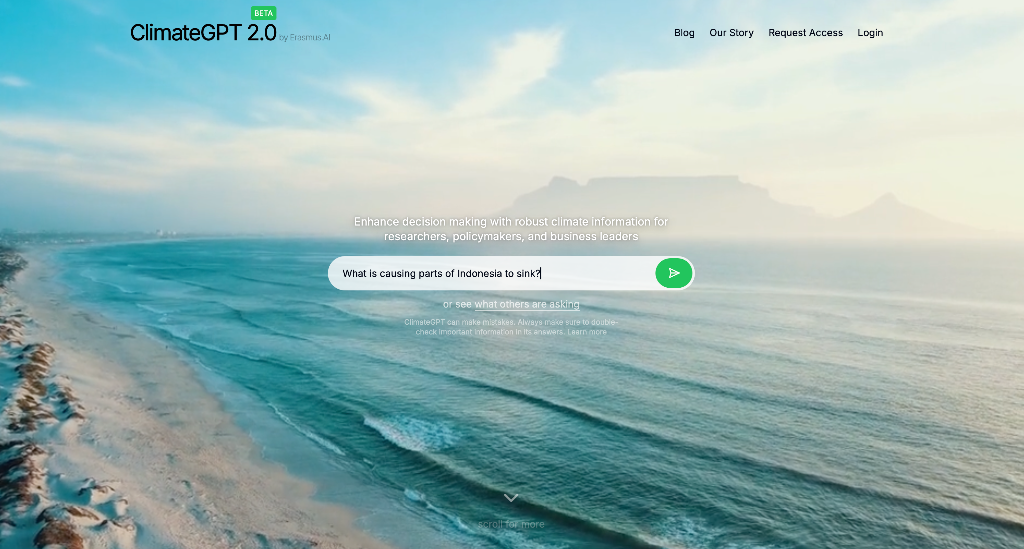
"We didn't train it to think like a machine. We trained it to think like the planet—with complexity, humility, and care."
— David Thulke, Lead Architect, Erasmus.ai
Why It Matters Now
We are not short on information. We're buried in it.
The Numbers Don't Lie:
- 2023 was the hottest year ever recorded, with global temperatures 1.48°C above pre-industrial levels
- Climate displacement is pushing 20 million people per year from their homes
- By 2050, climate stress may shrink global GDP by up to 18%
- Arctic sea ice has declined 13% per decade since 1979
- Ocean heat content has increased by 450 zettajoules since 1970
- Extreme weather events have increased 5x since 1970, causing $3.64 trillion in losses
Still, action often stalls—not due to apathy, but analysis paralysis. The problem isn't data scarcity—it's synthesis capacity. We have terabytes of climate research, but accessing it requires parsing through dense academic papers, navigating institutional silos, and translating technical jargon into actionable intelligence.
ClimateGPT fixes that.
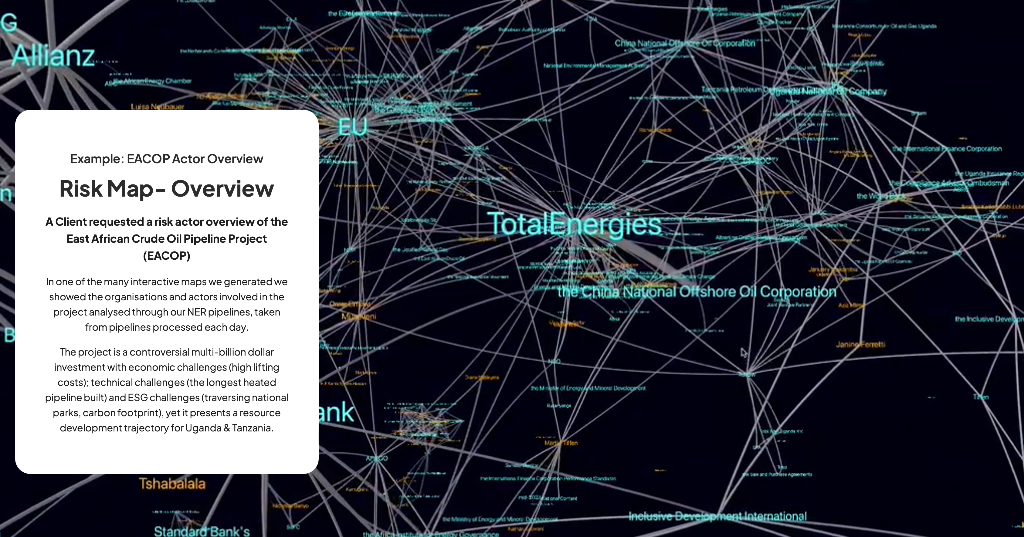
Every query runs through millions of peer-reviewed sources, policy documents, and real-time climate data—then returns contextualized answers that connect natural science, economics, and human impact. It gives governments traceable citations, educators lesson-ready explanations, and activists evidence-backed language—in over a dozen languages.
In short: it turns data into direction.
Climate Intelligence, Designed Ethically
Unlike many high-profile AIs that leave behind a trail of carbon, ClimateGPT was trained exclusively on hydropowered GPU infrastructure. Its multilingual model uses cascaded machine translation, making climate reasoning accessible from Nairobi to New Delhi.
Training large language models typically generates massive carbon footprints—some models emit as much CO₂ as five cars over their entire lifetime. ClimateGPT's creators chose a different path: renewable-powered computing, efficient model architecture, and a commitment to transparency.
It's open-source, scalable, and governed by a principle that echoes the Earth's own systems: interdependence.
This Is Where Donors Come In
ClimateGPT is not another product launch. It's a public good—a tool for building climate literacy, institutional clarity, and shared global understanding.
Our Donor Advised Fund is proud to back this effort, alongside grant partners focused on expanding climate literacy tools in schools and universities, integrating ClimateGPT into disaster resilience planning, supporting multilingual access for indigenous communities, and accelerating global south research collaborations.
Consider: the World Bank estimates that climate adaptation requires $140-300 billion annually by 2030. Yet less than 2% of global philanthropic capital flows to climate solutions. Meanwhile, most climate funding goes to mitigation—not the knowledge infrastructure that enables informed decision-making.
ClimateGPT bridges this gap. It's not just software—it's cognitive infrastructure for the climate century.
What Happens If We Don't?
We can keep building walls between science, policy, people, and funding.
Or we can build bridges—like ClimateGPT—that connect, contextualize, and empower.
This project doesn't ask for your sympathy. It invites your strategic vision.
History Remembers What We Chose to Fund
Years from now, we may look back and wonder:
Why did so many systems fail?
Why didn't they act sooner?
Let this be one of the stories where we answered:
We didn't wait. We funded the intelligence that helped us find our way.
"Climate change isn't just a crisis. It's a communications emergency. This is how we respond."
— David Thulke, Lead Architect, Erasmus.ai
Your capital can help the world understand itself—and act accordingly. Let's fund the mind our future needs.
This is the moment to stop polishing the optics—and start clarifying the record.
For ESG donors and SDG-aligned organizations, the opportunity here isn't more messaging. It's meaning. ClimateGPT doesn't just ask us to care—it shows us where caring counts. It's intelligent, honest, and unapologetically focused on getting it right, not just getting attention.
In a space too often clouded by performance, this is clarity with purpose—wisdom, scaled.
If you've ever said you want to help build a better world, this is where you can prove it.
Sources & References
ResearchGate
"Academic research on embedding Indigenous values in AI design"
Related:
Blocks and Files
"Nanofiche solves the migration issue of digital storage by engraving information on inert metal that will last 10,000+ years, making data impervious to cosmic radiation"
Related:
Arch Mission Foundation
"First library off Earth carrying humanity's knowledge to the Moon"
Related:
Interdisciplinary Research
"Indigenous reciprocity and regenerative design both emphasize holistic, long-view systems. Together they encode ethics, ecology, and community into durable practice and technology"
Related:
About Erasmus.ai
Artificial Intelligence & Social Intelligence
Erasmus.ai, the creator of ClimateGPT, builds tools to make us collectively smarter. The task of Generative AI is not to make lonely savants, but to amplify our social intelligence so that collectively we can address 21st Century challenges.
Erasmus.ai is a Generative Artificial Intelligence & Social Intelligence platform leveraging Large Language Models (and other techniques) to reveal context, empower for sense-making & sense-breaking across any issue.